How Lingk Uses AI to Accelerate and Modernize the Integration Journey
Across every industry, organizations depend on data flowing reliably between their systems. Yet integration projects are still notorious for being slow, expensive, and resource-intensive—often stretching months beyond expectations and consuming precious IT capacity. At Lingk, we believe this outdated model holds institutions back. The future of integration isn’t more people or more code. It’s AI-driven delivery, with experts who understand your outcomes.
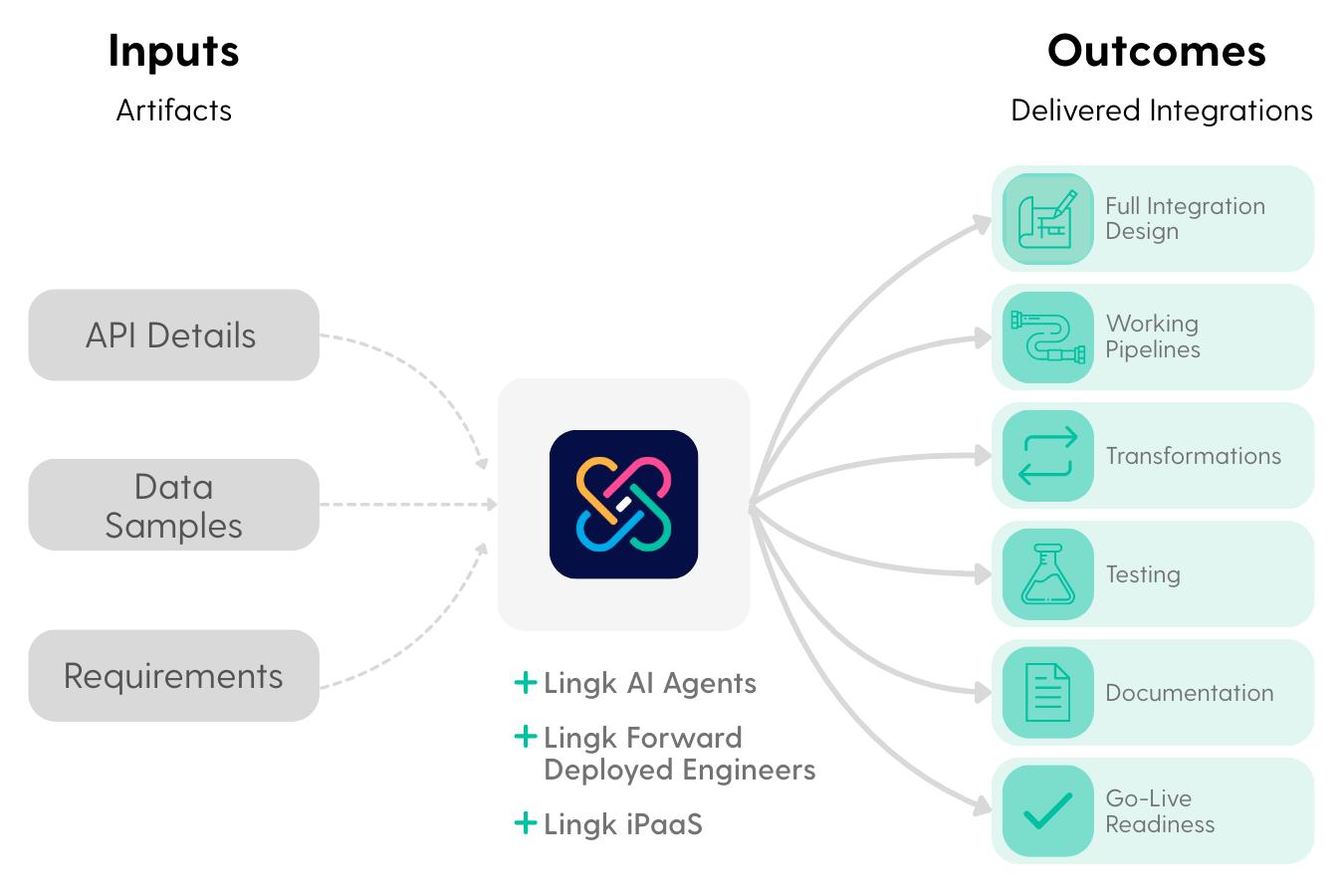
This is the foundation of Orchestra, Lingk’s AI-powered delivery model that’s powered by AI agents and led by Forward Deployed Engineers (FDEs) to design, build, test, and document integrations faster and more affordably than traditional methods. With Lingk, organizations can finally modernize their integrations, eliminate backlogs, and get the data foundation they need—without the years of technical debt.
AI-Driven Delivery: Accelerating Integrations From Months to Minutes
At the core of Orchestra are Lingk’s AI Agents—digital labor that analyzes customer artifacts such as sample data, API details, and a short list of requirements. Instead of spending weeks mapping fields, writing scripts, building pipelines, or troubleshooting mismatches, our AI Agents generate complete integration designs and working components in minutes.
These agents are trained on Lingk’s own low-code integration language and workflows, enabling them to generate integration recipes, perform data mapping and automate each stage of the integration lifecycle: Discovery → Design → Development → QA → UAT → Go-Live.
Forward Deployed Engineers: Human Expertise That Steers the AI
AI acceleration is powerful—but successful integration still requires context, understanding, and human guidance. That’s where Lingk’s Forward Deployed Engineers (FDEs) come in.
Embedded as part of your team, FDEs orchestrate the AI Agents to ensure integrations reflect your real-world processes, institutional goals, and governance standards. They meet regularly with your stakeholders to understand your systems, data models, and business rules. Then they translate that insight into precise direction for the AI Agents that execute the work.
Rather than billing hours or simply providing tools, our service model delivers outcomes. Each integration is designed, built, tested, and validated under their supervision, ensuring it works on day one.
For organizations juggling overextended teams or backlogged projects, FDEs can supplement or replace internal integration capacity. Your staff stays focused on mission-critical work, while Lingk’s team ensures integrations move quickly, accurately, and predictably through the finish line.
Rhythm: The iPaaS Platform Built for Modern, AI-Powered Delivery
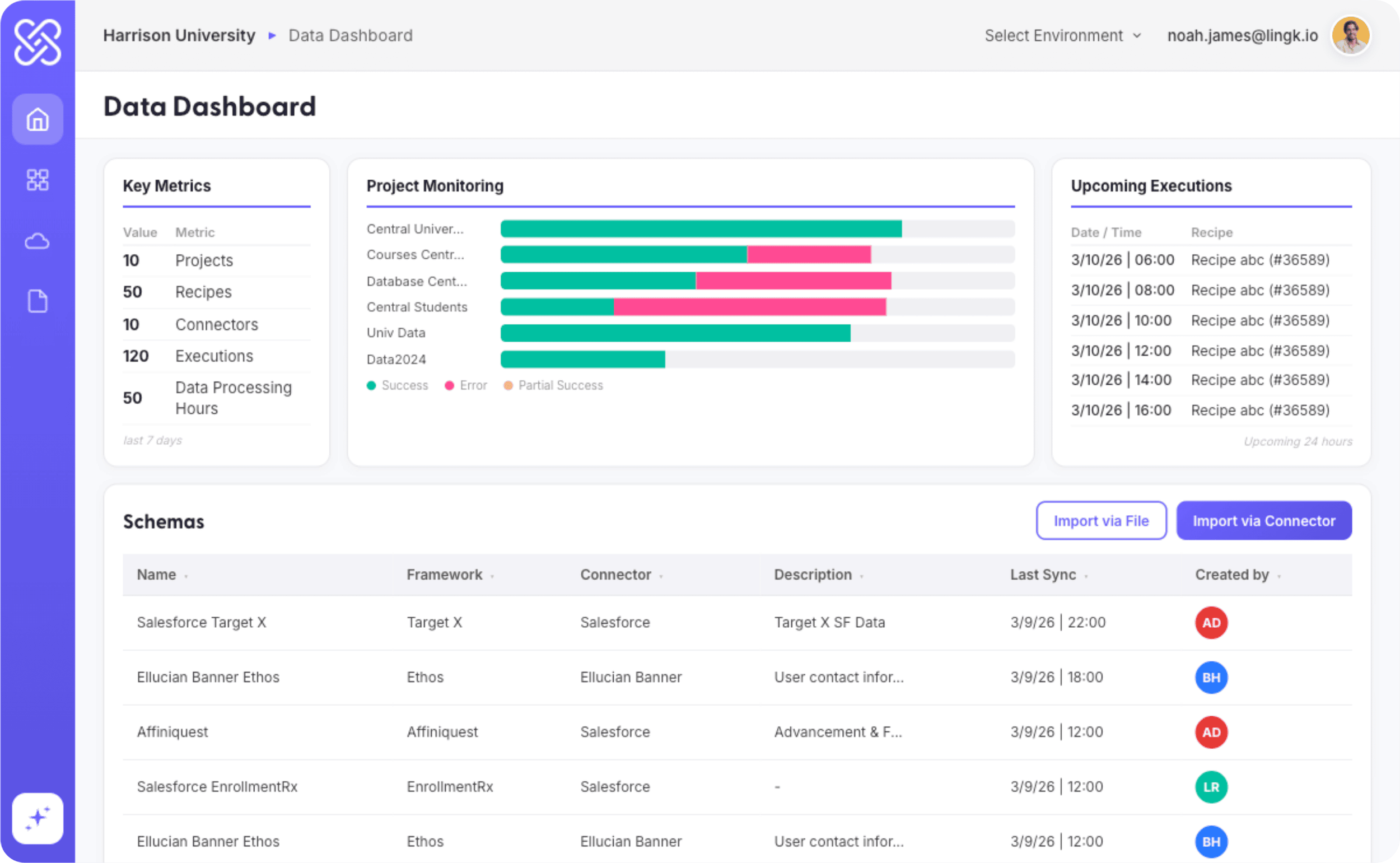
At the foundation of Orchestra is Rhythm, Lingk’s enterprise iPaaS. Rhythm powers real-time pipelines and massive-scale data movement. Rhythm is built differently from traditional integration platforms: it is serverless, and powered by Apache Spark—designed to process billions of rows of data instantly.
With built-in capabilities for scheduling, event triggers, retries, duplicate prevention, and end-to-end monitoring, Rhythm ensures that integrations are robust, reliable, and observably clean.
A Modern Approach: Simple Inputs, Powerful Outcomes
Traditional integration projects require endless back-and-forth: gathering detailed requirements, deciphering legacy processes, negotiating architecture decisions, and waiting weeks for internal teams or external consultants to complete development.
Lingk removes that friction.
All we need from your team is a few simple artifacts—a data sample, a description of the workflow, and the relevant API details. From there, our AI Agents analyze and generate the integration. Our FDEs validate it, collaborate with your team, and guide it through testing and deployment.
The result is a fully delivered integration—designed, built, tested, and documented—without requiring your internal teams to become experts in integration languages, data models, or pipeline engineering. You get faster delivery, higher accuracy, and significantly less effort.
Why Organizations Are Turning to Lingk’s AI-Powered Delivery Model
Whether you’re modernizing legacy flat-file integrations, connecting cloud applications, eliminating technical debt, or building a unified data ecosystem, Lingk transforms how integration work gets done:
Faster integration timelines
One-time, outcome-based pricing for integration services
Reduced dependency on scarce IT capacity
Higher quality through AI-driven consistency
Enterprise-scale performance on a modern no-code/low-code iPaaS
By combining digital labor with expert human oversight, Lingk offers a new, more efficient way to modernize and manage integrations.
